
Simply Christian
Part 14: An ordered life is not superior, it is Christlike

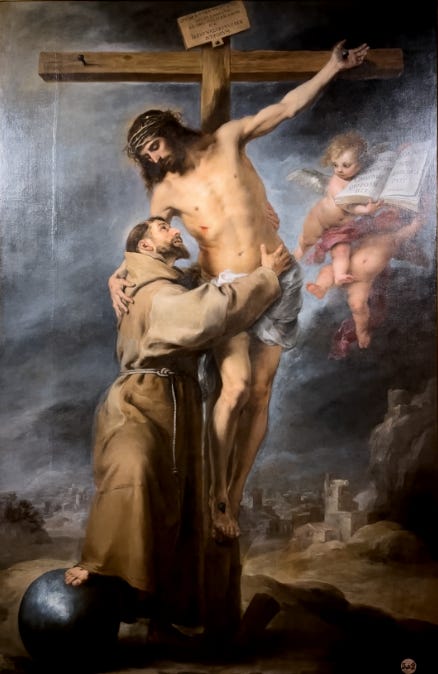
In the epistle for the Second Sunday after Epiphany, Saint Paul’s opening address to the Corinthians reminds us that being a saint isn’t an earned status. Our holiness comes from Christ, not our achievements. Liberating and refreshing as this may be, we Christians love looking for a way to “rank” ourselves.
This made me ponder how attempting to live by a Rule of Life could cause us to think that somehow made us “better”. While thinking about this I stumbled over a comment by St. Francis that relates to this. Unsurprisingly, he grasps the truth of 1 Corinthians, and therefore doesn’t envision being in a religious order as something exceptional, rather just an attempt to be ordinary. In The Testament he writes:
“After the Lord gave me some brothers, no one showed me what I had to do, but the Most High Himself revealed to me that I should live according to the pattern of the Holy Gospel.” —St. Francis of Assisi, The Testament
The Franciscan order wasn’t established by Francis of Assisi to produce extraordinary Christians. To Francis, it was a group of people given by the Lord to try and be ordinary gospel people. I think this is a beautiful description of what a Rule of Life could do for us.
In a wonderful book of reflections on his order, Franciscans Jovian Weigel and Leonard Foley say this of the founder:
“The last thing Francis wanted was to be special or to found a group of people who would be distinguished or superior. He simply wanted as many people as possible to be led by the Holy Spirit to live the Gospel of Jesus Christ, allowing the Lord to transform their lives.”1
Of course, we might then ask, “Well what does it even mean to have a Rule of Life, what could it even do?” To which they offer this wonderful line:
To be Franciscan is to attempt to be Christian, a disciple.2
There’s no question that the language of Rule of Life, or even the Ordered life, is having a moment right now. It’s popular, it sells well, and we buy the books. But what one of the OG “ordered” saints tells us is that all we need to really follow a Rule of Life, is the gospel. To live an ordinary Christian life is, in itself, extraordinary, but it’s all contained in gospels about Jesus. St. Francis was well known for saying of the Gospels, “He is speaking to us today.” And so he listened, and encouraged us to do the same.
•
G.K. Chesterton, in his book on St. Francis, opens up to us a shocking, heretical sounding, idea of what this ordinary could mean. He leads into the idea by saying this:
The difference between Christ and St. Francis was the difference between the Creator and the creature; and certainly no creature was ever so conscious of that colossal contrast as St. Francis himself. But subject to this understanding, it is perfectly true and it is vitally important that Christ was the pattern on which St. Francis sought to fashion himself…3
Chesterton then ponders an outrageous, brilliant, and ultimately true idea, echoing how St Paul opens his first letter to Corinth. Chesterton suggests that Francis did fashion his life on Christ, that he was a “Mirror of Christ”, as we all are invited to be. As such he states:
…if St. Francis was like Christ, Christ was to that extent like St. Francis.4
I think that Chesterton is right. Not because Francis was extraordinary, but because this is exactly what ordinary Christians can be. This is what our Rules of Life should do. Make us mirrors of Christ, so that Christ looks like us. Chesterton concludes:
St. Francis is the mirror of Christ rather as the moon is the mirror of the sun. The moon is much smaller than the sun, but it is also much nearer to us; and being less vivid it is more visible. Exactly in the same sense St. Francis is nearer to us, and being a mere man like ourselves is in that sense more imaginable.5
•
Hopefully around about now you remember that this sounds not dissimilar to what St. Paul said to the Corinthians in a later letter:
“And all of us, with unveiled faces, seeing the glory of the Lord as though reflected in a mirror, are being transformed into the same image from one degree of glory to another; for this comes from the Lord, the Spirit.” (2 Corinthians 3:18 NRSV)
In his sermon The Mirrors of the Lord, George MacDonald brilliantly notes that our modern scientific notion of a mirror blurs our understanding of this passage. Because we know that a mirror reflects light back to us, we assume that’s what’s happening to glory here. MacDonald guides us to an ancient understanding. That Paul would have thought of a mirror as something that somehow received, absorbed the image presented to it. He offers this as a “reading” of the verse:
The prophet-apostle seems to me, then, to say, ‘We all, with clear vision of the Lord, mirroring in our hearts his glory, even as a mirror would take into itself his face, are thereby changed into his likeness, his glory working our glory, by the present power, in our inmost being, of the Lord, the spirit.’ Our mirroring of Christ, then, is one with the presence of his spirit in us. The idea, you see, is not the reflection, the radiating of the light of Christ on others, though that were a figure lawful enough; but the taking into, and having in us, him working to the changing of us.6
This invites us into transformation, transfiguration, and change, not simply to reflect, but to become. Hear MacDonald make his point again:
Paul's idea is, that when we take into our understanding, our heart, our conscience, our being, the glory of God, namely Jesus Christ as he shows himself to our eyes, our hearts, our consciences, he works upon us, and will keep working, till we are changed to the very likeness we have thus mirrored in us; for with his likeness he comes himself, and dwells in us.7
I think that St. Francis would say that this isn’t an extra special way to be Christian, it’s just what Christ is wanting to do in all of us.
So in all your pursuits, may you be ordinary, may you mirror Jesus, and may you be like Christ so much so that Christ is like you.
If you’d like to join as a paid subscriber and support my writing, then I’d deeply appreciate it. I use that support to fund a book project rather than create a paywall on new posts. Not everyone wants to take on a paid subscription though, I get that, but sometimes we all like the chance to say “thanks”. So there’s also a “buy me a book” option if you’d prefer.
Jovian Weigel and Leonard Foley, Live Like Francis, p.11.
ibid.
G.K. Chesterton, St. Francis of Assisi, p.99.
ibid. p.100.
ibid. p.101.
ibid.