
Hope cannot be Grasped
A listening that helps us see | Easter Sunday, Year A

†
I don’t know which version of the news you encountered this week. I was particularly struck by the unfolding narrative of the Artemis II mission. As we sit here, living humans are further from our home planet than they have been in many of our lifetimes. The various aspects of the mission are fascinating, the launch capturing our attentions around the world. But then the human effort has faded into the background when the pictures of the planet from outside of our orbit start to appear on our phones. A 40 year update to the previous picture it turns out, despite all that has happened since the 1970’s, when viewed from the heavens, Earth is still beautiful, or as was said at the beginning, it is “good.”
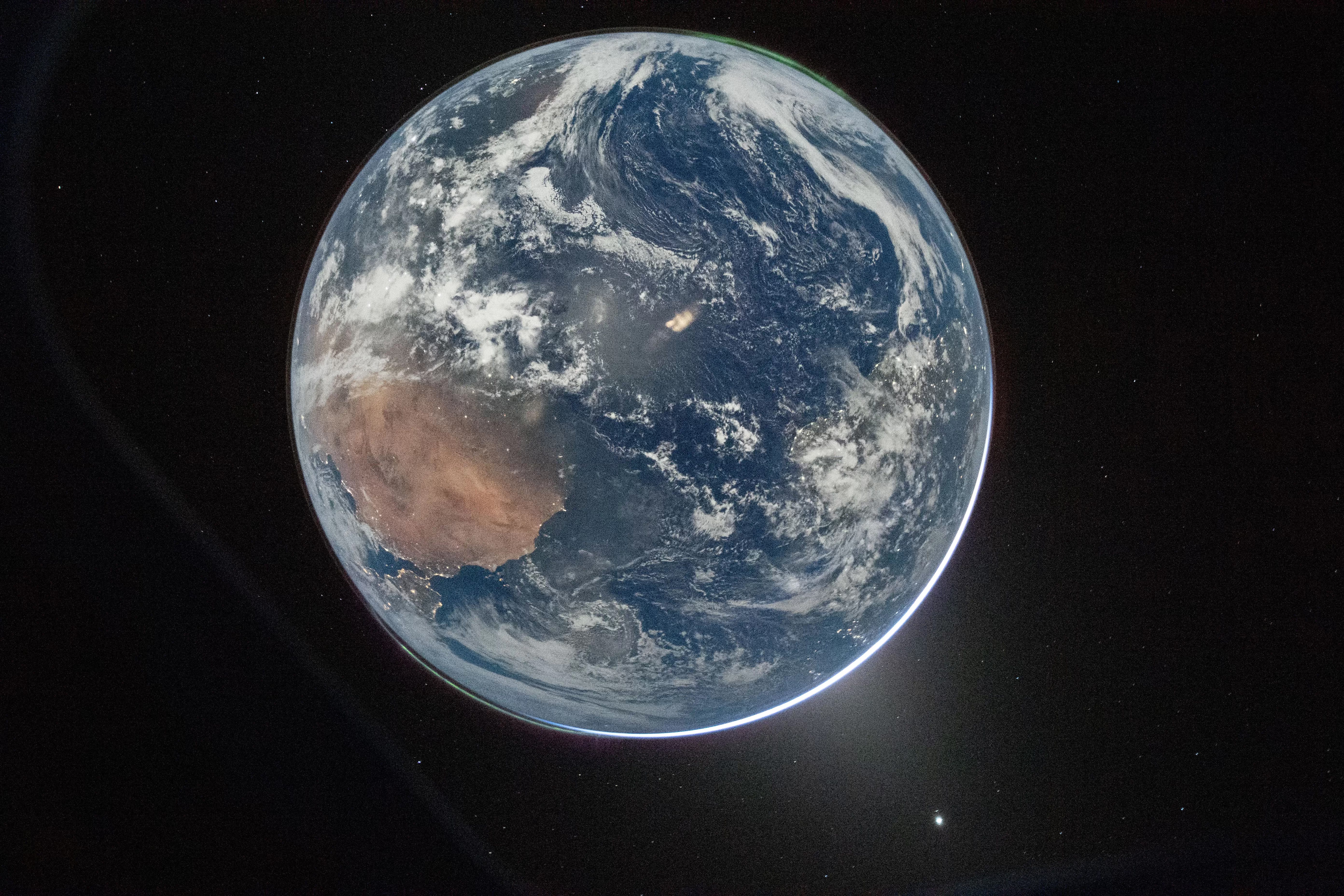
As we should have expected, once these pictures were posted online the internet did not fail to deliver. “It may look good from up there,” one comment said, “but you should see what it looks like down here!” Their position isn’t entirely unwarranted. While we were awed by pictures of our planet world leaders were taking it in turns to threaten increasing versions of “raining down hell” on one another.
On a planet that looks like this from the heavens, we, who live here, threaten hell to one another. Over the price of gas.
Heaven from up there, Hell down here.
We live our lives caught between heaven and hell.
But we really do live our lives like that. We see the images of heaven and hell, we know they are both real, and yet somehow we also know that only one is really, deeply, true. Let me say it like this. Despite the images of chaos, war, violence, and other forms of hell, most of us still got up today, got dressed, ate breakfast, and then came to church. And then this week we’ll take our kids to school and go to work. Regardless of what we say we believe, whether you’re only in church on Easter to keep your mom happy or here every week (like some of our congregants), I am suspicious that if we can live in this world without giving up or falling into cynical despair, then something in us knows a deep truth. That deep truth is what we Christians call eternal life, at Easter we name it Resurrection.1 If you can live between the “looks good up there” and “is a mess down here” yet believe that the “up there” is the truer beauty, then you have what we call hope.
And hope changes everything.
•
Today’s Gospel brought us to Mary Magdalene caught between heaven and hell. Like the world today she finds herself in something like a surreal nightmare in the aftermath of the death of Jesus. The narrator paints the pictures of our lives in these seasons with stunning simplicity:
While it was still dark…(John 20:1)
Some of the church’s greatest thinkers have said that rather than being a place like shown in some movies, Hell is what happens when we lose sight of God.2 When we think that down here, rather than “up there,” is the true story. When our world leaders threaten untold violence. When the doctor delivers bad news. While it was still dark.
What most of us call hell is our inability to see God.
But Mary is not in Hell. Despite the pain, the sadness, the disappointment, she goes to the tomb. This is an act of hope. She doesn’t expect an empty tomb, she doesn’t expect to see Jesus. Her hope is just a quiet refusal to believe that the evil that killed Jesus gets to have the last word.
And so we find her, while it was still dark, at the tomb. An empty tomb.
The narrative drops now into a buzz of movement. Running backwards and forwards. Out of breath disciples, some fast, some slow. Angels. Two actual angels. No one understands what’s going on, until eventually Mary finds herself turned around and face-to-face with Jesus and trying to grasp hold of him.
I understand this. It’s what I do. When I lose sight of God, when Hell feels near, I grasp for control. When you think you have lost sight of God, of the good, of the true, you do the same. When Hell —whatever that is for you— threatens to close in, we try take hold, to make things happen the way we want. Like Mary, we want to grasp onto the solution and not let go.
But to grasp is a death move. It was death’s move. On Friday, on the cross, Christ was grasped by death. The grave took hold of him. Or so it seemed.
Jesus does not grasp however. Jesus trusts. Even in the darkness when it seems hard to see, he listens to his Father. The situation looked bleak. As does so much of our world - war, violence, pain, illness, fear. Yet, Jesus still trusted. He listened. Christ was grasped by death, but held by the father. In grasping Christ, death died. In trusting God, Christ was raised into life (Acts 10:40).
•
So what do we do? When we’re in hell, when “down here” seems more real than “up there”? When we lose sight of God?
We do what Christ did. We do what Mary will do. We do what God told the disciples on the mountain at the start of Lent: Listen to him (Matthew 17:1-9). Hope isn’t rooted in what we see. Thanks be to God. The images of war on the news, or our worst nightmares that haunt our dreams, will always damage our ability to hope. We need something deeper, truer, more trustworthy than what we see. We need to listen. Listen to the one who descended deeper than all our hells. Who knows, from the inside of death, that God still held him
When the running and turning stops Mary finds herself face to face with what she thinks is a gardener, but in the quiet she listens and she hears: Mary (John 20:16). God told us to listen, and when we do, we hear. Not clever theology, not brilliant ideas, not life changing notions. We hear our name and we can trust again. Mary’s hope is rooted in a god who knows her name. In the midst of all your chaos and devastation the resurrected Christ whispers your name more loudly than death and all its powers of fear, anxiety, pain, and shame. And you can listen and trust him.
Like Mary, we are all looking for the signs of God. The flourishing of hope in our hearts when we see the NASA pictures dares us to believe. The pictures of the shells of bombed houses cause us to doubt. But hope is deeper than what we see. The empty tomb told us that.
The invitation of Easter is to look at the beautiful planet in the pictures and trust that it is loved by God. To believe that all the hells we encounter here will not get the final word. The stunning turn of Easter is that that very God faced down death and hell, and knows your name. And while we are looking for signs of hope, like Mary discovered, Christ is calling to us: to listen to him and to trust him.
That is where our hope is found. So when he calls your name—and he is calling your name—you can trust him.
And that hope changes everything.
Amen.
My new book, with Cody Matchett, Hearing in the Dark: Reflections on Christian Spiritual Formation is now out and available on Amazon. We’d love for you to pick up a copy and leave us a review. It’s a small book, easy to keep on a night stand for some bedtime reading, or drop in your bag to read during a quiet moment. We hope you like it.
Karl Rahner, The Great Church Year, p.184.
Hans Urs von Balthasar, Mysterium Paschale, p.165.