
Nostalgia for the Future
The cross is the shape of everything | Christ the King, Year C

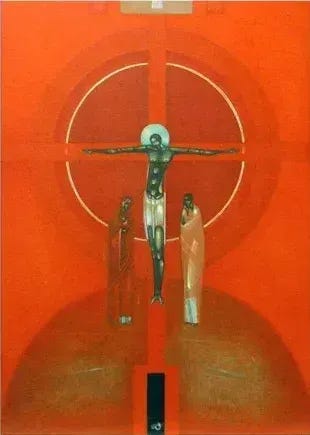
This Sunday, the final Sunday in the Christian Calendar year is known as “Christ the King”. It marks the journey of the Christian year. We begin an new Christian Year (Year A) next week with Advent “expecting a King” we will welcome the king at Christmas, see him crucified, resurrected, ascended and sending the Spirit at Pentecost, but all of this tells the same story. Christ is King.
Do we really need to be reminded that Christ is King? This day is the newest in the church calendar. It appears for the first time in the 1920s as a reminder of Christ’s Kingship in the face of rising fascism and nationalism. So you decide if we still need it or not! But we also need to remember what kind of king he is, and that’s what our worship today draws us into.
†
What does it mean that Christ is King?1
The first thing the Gospel wants us to hear is that it does not mean what we think it means. We are shown Christ on the Cross, crucified. Then, and only then, we are told that he is “king of the Jews.” Of course, as you know, it’s not quite as simple as that. The title above him is mentioned in the midst of a stream of insults and mockery. But here lies a truth found in Luke’s gospel. The things people say in mockery, jest, or accusation often turn out to be truer than they realize: “This man welcomes sinners and eats with them.” Well, yes, he does. Thanks be to God. This crucified man is the king of the Jews, Well, yes, he is. Thanks be to God.
The Gospel, as it turns out, has a habit of being found in our insults.
This means that we must pay attention to what’s happening in a text like this. If the insult is true, then we must listen more attentively. Our eyes deceive us. This man doesn’t “look” anything like a king. Precisely the opposite.
The insults tell the truth about Jesus, but they also tell the truth about ourselves. We are uncomfortable with a king who looks like this. This fits with none of our concepts of power, leadership, or prestige. So we mock. We’ve gotten good at mocking. Made an art form of it. This is not a cheap dig at the social media companies. We love to blame social media, but social media has just made famous what was always in our hearts. We want to bring people down.
“Come down from the cross,” we cry. Secretly we know that there’s more to his elevation on the cross than shame. But the insults mask our discomfort. We want Jesus to come down from the cross. Please let it not be true that this is our king.
So let us hear the Gospel again, in its most humbling form: “Father, forgive them, for they do not know what they are doing.” (v.34). Jesus forgives us in our naivety. Somehow, Christ in his glory, doing exactly what is foreign to us but purposed by the Trinity, reveals our own unknowing, and thus exposes an anthropological problem: Not knowing what we are doing doesn’t stop us from doing [anything].
“Come down from the cross!” We project our comfortabilities onto our spirituality. We want a Jesus on our level, in our image. We are less comfortable with a Jesus who is the image and fulness of the invisible God, as Colossians tells us, if he looks like this. So our doing becomes insults, mockery, taunts, and harm. We do actually want a king. Despite what we say in protest. We just don’t want a king (or any politician and leader) like the kind we seem to keep getting. But deep down we know we need a king. So we are open to a king who goes through the cross. But we are not ready for this. A king on the cross.
The Orthodox theologian Alexander Schmemann tells us what we need to hear:
“Christ was never more a king than when He walked to Golgotha carrying His own cross on His shoulders while the hate-filled and mocking crowd surrounded Him. His kingship and power were never more obvious than when Pilate brought Him before the crowd, dressed in purple, condemned to a criminal’s death, a crown of thorns on His head, and Pilate telling the raging mob: ‘Behold your king.’ Only here can the whole mystery of Christianity be seen, for Christianity’s victory resides within the joyful faith that here, through this rejected, crucified and condemned man, God’s love began to illumine the world and a Kingdom was opened which no one has power to shut.”2
Theologically we have to hold our nerve here. Ever so subtly most of us have learned to accept that the Cross serves as Christ’s “enthronement” process. That Christ is king because of his Cross. As if the cross is a stage on the journey. If that is all there is to Christ’s cross, then it’s obvious that we would ask him to come down.
The alternative is to embrace the sapientia Crucis. The Wisdom of the Cross. This is the mystery of the Gospel. The Cross is not simply an event within the history of the world, or a moment in the divine life. It is the shape of all things.
This is what St. Paul is telling us in Colossians. The blood of the cross is what is holding together the peace of the universe. Don’t forget that in Paul’s context the notion of peace is understood as “wholeness” (shalom). So when Paul tells us that Christ, the image of invisible God in whom the fullness of God dwells, is the one who “holds all things together” we can know that he means that the cross is the linchpin of the universe. Everything is shaped, formed, and held together on the cross. It’s why at the centre of Christian worship throughout our history is the remembrance at the table of his broken body and shed blood. Therefore, Christ is never more king than right here under the sign that declares it. This is what it means for Christ to be king.
•
Surprisingly, it is at this precise moment we hear another, different voice in the Gospel. The voice of a wannabe disciple who cannot flee, like the other disciples have, but who has not chosen to stay, as Mary does. Amidst the cacophony of taunts to “come down,” we hear the voice of one of the thieves asking Jesus not to come down and save himself, but to “remember me.”
“Remember me”. I am struck that this is what Jesus told the disciples to do just hours before the cross. The notion of memory often draws us into nostalgia, a longing for what has gone before. It’s often rose-tinted. Too many of today’s thought leaders and influencers encourage us to long for life as it was 40 or 50 years ago, forgetting that it was “good and free” as long as you were not Black or Indigenous or a woman. But this is not what Jesus or the Thief’s “remember” means. It’s not a yearning for what has gone before, but a longing for a future. In Christ our nostalgia, our remembrance, pulls us into his future. “Remember my death” he says, before he dies, and “…today you will be with me in paradise.” Rose-tinted memories of lost glory are nothing when we see the true glory of the Cross.3
In a sermon in 2010, Pope Benedict XVI offered a wonderful observation on this particular paradox of Calvary:
Then there is the faith of the Good Thief: a faith barely outlined but sufficient to assure him salvation: “Today you will be with me in Paradise” . This “with me” is crucial. Yes, it is this that saves him. Of course, the good thief is on the cross like Jesus, but above all he is on the Cross with Jesus. And, unlike the other evildoer and all those who taunt him, he does not ask Jesus to come down from the Cross nor to make him come down. Instead he says: “remember me when you come into your kingdom”.
The Good Thief sees Jesus on the Cross, disfigured and unrecognizable and yet he entrusts himself to him as to a king, indeed as to the King. The good thief believes what was written on the tablet over Jesus’ head: “The King of the Jews”. He believed and entrusted himself. For this reason he was already, immediately, in the “today” of God, in Paradise, because Paradise is this: being with Jesus, being with God.4
When we, his disciples, no longer flee or demand that he come down from the Cross, we are able to hear a different story. We hear not just the deep cry of our souls, “remember me”, but his call, his summons, the summons only Emmanuel (“God with us” - the Advent promise) can make: “that you will be with me.”
The gospel calls us to be with Jesus. But with this Jesus. Not the Jesus of our fantasies and desires, but the King upon the cross. He is the head of the body (Colossians 1:18). Somehow, therefore, this King, in this scene, draws us up into our humanity. William Stringfellow, the Episcopal lawyer, said
“In the face of death, live humanly. In the middle of chaos, celebrate the Word. Amidst babel, I repeat, speak the truth. Confront the noise and verbiage and falsehood of death with the truth and potency and efficacy of the Word of God. Know the Word, teach the Word, nurture the Word, preach the Word, defend the Word, incarnate the Word, do the Word, live the Word. And more than that, in the Word of God, expose death and all death’s works and wiles, rebuke lies, cast out demons, exorcise, cleanse the possessed, raise those who are dead in mind and conscience.”5
“In the face of death, live humanly.” The kingship of Christ on the Cross calls us to a death to all the mockery and taunts that diminish our humanity, it really is a call to life. This is why Paul can say to the Galatians,
“I am crucified with Christ. The life I now live in the flesh I live by trust in the Son of God who loved me by dying for me.” (2:19-20)
Our struggle to see Christ as King on the Cross highlights how lost we are to our own humanity. We strategize, scheme, and plan how we’d like our lives to go. But it’s a vision not rooted in remembrance of the cross. We know what needs to be done. We call him to come down and save himself. Which all seems good to us, better even, until it isn’t.
The problem is, and I know you’ve seen this, if not experienced it, a faith that avoids remembrance of Christ’s cross lacks the substance for anything other than the good times. When life invariably doesn’t work like the books and influencers say it will, what do then except learn that we cannot save Jesus from the cross, we can only accept that the Cross will save us. Christ wants us to know, like the thief, that he is with us. Where is God when we suffer, when the world suffers? He is on the cross with us.
Quite simply, that’s what it means for Christ to be King.
I’m not sure if we can yet tolerate the idea of a crucified Messiah. We definitely prefer Jesus to be King as a result of his Cross, but I’m not sure we like the idea that he is King on the cross. My guess is that we don’t like this, not because we don’t like Jesus on the cross, but because deep down we know that the Thief is right. As much as we would like Jesus to “come down”, the call is for us to be with him.
To hear this and know it as true, I think is what we call “the wisdom of the cross” and how we know that Christ is exactly the king that we need. Frederick Buechner gives us what I think can be the last word:
“There is little that we can point to in our lives as deserving anything but God’s wrath. Our best moments have been mostly grotesque parodies. Our best loves have been almost always blurred with selfishness and deceit. But there is something to which we can point. Not anything that we ever did or were, but something that was done for us by another. Not our own lives, but the life of one who died in our behalf and yet is still alive. This is our only glory and our only hope.”6
Amen.
"Nostalgia for the Future"

Small Group Notes: These are notes based on my sermons to encourage people to gather with friends or church family and discuss the lectionary texts for the weekend. You could gather in a home, a bar, or a coffee shop, and use them to guide your growth and formation.
If you’d like to support my writing here, but for a discounted “Black Friday” rate, click the button before December 4, 2025.
This is a development of Thursday’s sermon. Very similar, but it develops differently in a few places.

I’m grateful to Richard Beck for chatting me through some of these ideas about nostalgia that will undoubtedly my Advent reflections this year. Also to AJ Jansen for pointing out that Christ’s “remember me” is before his death.
William Stringfellow, An Ethic for Christians and Other Aliens in a Strange Land, p.142-143
Frederick Buechner, The Magnificent Death, p.89