
Hospitable Babbling
The Boundary Ignoring Spirit of Pentecost | Pentecost, Year C

†
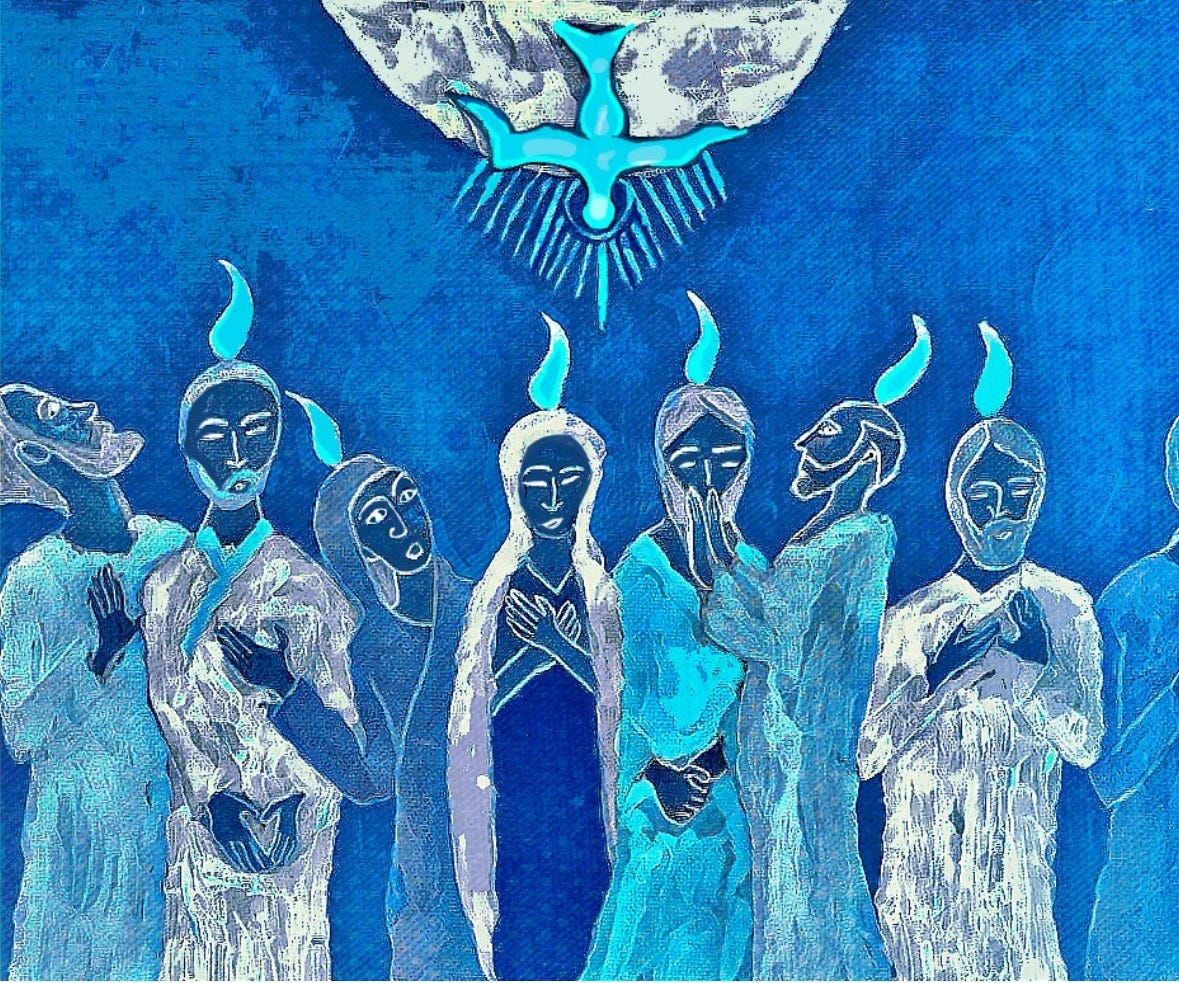
What do we do with something like Pentecost?1 It’s not that people aren’t lining up to tell us “what it means”, and perhaps I’m just another one, but the texts for Pentecost do offer us something of a guide to understanding Pentecost.
The Acts 2 account of Spirit-inspired speech in other languages, so the lectionary wants us to see, glances over its shoulder at Genesis 11’s narrative known as the Tower of Babel. This proto-Babylon2 vision of what we might call “power” or “imperial” does what those types of things often (some would say always) tend to do. They normalize.
Hear this clearly from Genesis 10. The world did not always have one language. By the time we get to Genesis 11, Babylon has had its way with the world, making it monochrome, normalized, the same.
But notice what Scripture offers us. Just before we get to the tower story in Genesis 11, chapter 10 offers us that much beloved biblical style - the genealogy. But if we pay attention to the genealogy of Noah’s sons at verses 5, 20 and 31, we see this line repeated: by their families, their languages, their lands, and their nations.
Did you hear it? Their languages.
So by the time we arrive at verse 1 of chapter 11 and we hear this, Now the whole earth had one language and the same words, we are supposed to realize that an imposition has happened. A normalizing, an ordering, a uniformity has happened.
This is the tale as old as time. Pick any point in history and you will see powerful people, organizations, empires, and philosophies trying hard to make us all similar. Willie James Jennings names this as something we see, in its most demonic form, in modern colonialist enterprises,
Imagine peoples in many places, in many conquered sites, in many tongues all being told that their languages are secondary, tertiary, and inferior to the supreme languages of the enlightened peoples.3
I think that it’s in this that we see the genius of Pentecost and the heart of God. What if we read the story of Pentecost the way that Emilio Alvarez does
Pentecost is the anti-Babel event in the life of the Christian church, and as such it contradicts and counteracts any divisive monopoly toward a spirituality lacking immersion into cultural and linguistic diversity. In doing so Pentecost promotes a multiethnic, multicultural, and multilingual approach to our Christian faith.4
The church is empowered on Pentecost not to go and normalize the world, but to be the people of Jesus for the world in its diversity. The disciples understood that day that promise of the Spirit on “all Flesh” that the prophet Joel spoke about wasn’t a Christianized Babel, but that Jesus was superseding boundaries of culture, politics and language.
I think humans are naturally resistant to that, which is, I think, why this needs Pentecost. We need the Spirit to lead us, as Romans 8:14 tells us, into what it is to be the Children of God. We’re not going to get there on our own.
Alvarez continues brilliantly,
While everyone has a first language of Christian spirituality or faith (be it Roman Catholic, Methodist, Anglican, Pentecostal, or Orthodox), the Spirit on the day of Pentecost propels believers to go beyond their established language of faith into an empowered, multilingual experience of Christian spirituality. Christians who believe in Pentecost as an anti-Babel event should be able to exhibit not only cultural multilingual sensitivity but also an ecumenical and Spiritual multilingual ability as well. If we are all one church and indeed the body of Christ, then Pentecost brings us together. It is at Pentecost where I keep my primary language of Pentecostal Christian spirituality but also acknowledge and yearn to learn a second or third language of Christian spirituality and faith.5
I often ponder whether the first disciples “get” this so quickly because of Jesus’ words to them in our Gospel reading today, “Peace I leave with you; my peace I give to you.” (John 14:27). The Hebrew idea of “Peace” is less about ideas of violence and more a notion of wholeness. Shalom is an anti-Babel idea. Pentecost is about wholeness.
A gift of the Spirit at Pentecost is that we see the dream of God, a vision of heaven, and it’s not normalized, it is “in our own languages we hear them speaking about God's deeds of power.” (Acts 2:11). So as they ask, we ask, “What does this mean?” I like how Jennings answers this question. It means, “God…is way ahead of us and is calling us to catch up.”
So rather than being the babbling of drunk people, the Spirit of Pentecost invites us into a radical hospitality of wholeness. We experience it every time we come to his table, as the liturgy says:
We break this bread to share in the body of Christ.
All Though we are many, we are one body, because we all share in one bread.
May this Spirit, this Pentecost Spirit, be with us as we go from the table, not to colonize the world, but to speak about this God.
Amen.
Postscript:
It shouldn’t probably be missed that the confusion of language in Genesis is not around speaking but hearing. Genesis 11:7 notes, “…they will not understand (Hebrew Shema) one another’s speech.” So it’s a gorgeous moment in Acts 2:11 when the people encounter all these languages in worship and say, “how is it that each of us hears them in our native language?”.
Pentecost is a miracle of hearing.6
This is my homily for midweek Eucharist (Pentecost, Year C, 2025)
Babylon and Babel are the same word in the Hebrew Texts of Scripture.
Willie James Jennings, Acts: A Theological Commentary on the Bible, p. 30
Emilio Alvarez, Pentecost, p.35
Emilio Alvarez, Pentecost, p.35
Thanks to Cody Matchett for this reminder post-homily.