
Harmony in Discord
Isaiah, St Paul, and the Virtual World | The 2026 St Anthony Institute Lecture

Each year at the Diocese of St. Anthony’s annual convocation the St. Anthony Institute, of which I am the director, hosts a lecture in honour of our founders, Bishop Ed and Gail Gungor. Our diocese has always taken academic reflection seriously, and many of our clergy have backgrounds in the academy or academic study.
This year’s lecture was set up as a conversation between Dr. Rickie D. Moore, Bishop Chris E.W. Green, and myself. We wanted to have a conversation around Scripture and Social Media. The title for the lecture came from a line used in the Eucharistic Prayer the evening before, “bring harmony to those in discord”. The double entendre seemed appropriate to our subject.1
The format for the lecture was an initial introduction, and then a conversation between the three of us. Here is my introduction.
•
“There are some,” St. Paul says in Galatians 6:12, “who wish to build their prestige by ensure you engage in a performative ritual to establish your status.” I’m relatively certain Paul is talking about circumcision, but he could be talking social media. In his Greek, St. Paul says, “there are some who wish to ‘make a good face’. Prestige, honor, and status, in the Ancient world, resided in the face — the mask we present to the world expresses how we would like to be perceived and treated.
In the last 16 years the world has subjected itself to a monumental shift in how we work, rest, and play (themes important from our last convocation). The dominant pioneer of this shift was a company called “Facebook”. It and others offered us multiple sites, apps, and features, to display our own thoughts, then pictures, and eventually videos that built our own status by inspiring jealousy in our friends or followers in just how perfect our kids were, wonderful our vacations seemed, or the brilliance of our casual musings. Humans, as St. Paul knew, are deeply motivated by prestige bias that leads us to copy and conform to that which we perceive is popular.
So it was probably no surprise that from 2010 onwards, when these apps became widespread, due largely to the ubiquity of the so-called smart phone, with their offer of “likes” and endless scrolling feeds, our world changed dramatically. This digital world shift is often traced to 2010 before exploding during the halt of our real world lives in 2020’s COVID-19 global pandemic. Our lives will never be the same, not because of the pandemic, but due to our navigating two often competing worlds — the digital and real. For us as pastors and Christians, we have in no way been excluded from this shift.
Paul’s contrast to a life of prestige bias is trusting participation in the cruciformed life of Christ. He too envisages a divided life — the death of himself and resurrection in the way of Jesus.
I have been crucified with Christ; and it is no longer I who live, but it is Christ who lives in me. And the life I now live in the flesh I live by faith in the Son of God, who loved me and gave himself for me. I do not nullify the grace of God; for if justification comes through the law, then Christ died for nothing.
You foolish Galatians! Who has bewitched you? It was before your eyes that Jesus Christ was publicly exhibited as crucified!
This is central to understanding Paul. While society operates on self-elevating individualism, Christ invites us into a community formed by the self-humbling crucified one (Philippians 2). In place of “face-improvement” Christ gives no status to the divisions of Jew/Greek, Male/Female, verified badge, blue tick, or “rising influencer” status. Paul’s ecclesiology means that to be Christian is a life that exists in Christ, built in trust and sacrifice. Notice how he starts chapter 3—that he himself is somehow a vision of trust in the sacrificed Christ for the Galatians. Furthermore, his prayer, in 4:19, is that Christ would be formed in them. This is his vision of being in the world as Jesus’s church.
In the Moral Vision of the New Testament Richard Hays frames it like this for us:
The distinctive shape of obedience to God is disclosed in Jesus Christ’s faithful death on the cross for the sake of God’s people. That death becomes metaphorically paradigmatic for the obedience of the community: to obey God means to offer our lives unqualifiedly for the sake of others. Thus, the fundamental norm of Pauline ethics is the christomorphic life. To imitate Christ is also to follow the apostolic example of surrendering one’s own prerogatives and interests. Within this world shaped by the story of Jesus Christ, the community wrestles with the constant need for spiritual discernment to understand and enact the obedience of faith.2
Hays calls this a “Hermeneutic of Trust”. To those of us immersed in the church, this likely seems somewhat saccharine—to the extent that it is easy for us to forget that trust is a counter-cultural move. Trust, rather than modernity’s “suspicion”, is the fulcrum of the Christian way. In place of the “hermeneutic of suspicion” which we were immersed in from childhood, Scripture invites us to a hermeneutic of trust. In contrast to modernity’s suspicion, and post-modernity’s anxiety, a hermeneutic of trust offers us this as a way to read:
Scripture is received as a truthful witness before it is dissected as a problem to be solved.
The Church’s task is discernment within a community of trust, not perpetual unmasking.
Moral reasoning is shaped by narrative coherence, not isolated prooftexts (or 180 Characters).
Essentially and crucially, this is Hays’ point: Christian ethics begins not with anxiety about deception, but with confidence that God has acted decisively in Christ.
We have come to learn that trust is not the way that social media shapes us to read the world. Social media functions almost entirely by a hermeneutic of suspicion. Consider the questions it encourages us to ask, almost unconsciously: Who is lying? Who is signalling? Who is hiding power? Who must be exposed?
This does not simply shape opinions; it forms people. Over time, suspicion becomes the habit of the heart. We end up living in what Jonathan Haidt describes as a state of chronic threat perception.3
So the question that presents itself to us, the Order of St. Anthony, as a non-geographic religious order that is held together by online prayer, is: How do we navigate a digital world, as pastors and members of a religious order, when that world trains us to read the world in a way that Scripture explicitly warns against?
To set up our conversation I want to observe that to be Christian in this digital world brings us present to two rival interpretive habits, which are only enhanced with the appearance of so-called Artificial Intelligence (AI).
The Hermeneutic of Suspicion (Social Media):
Assumes bad faith
Rewards exposure and condemnation
Forms communities through shared enemies
Trains anger as vigilance
Makes trust feel naïve
The Hermeneutic of Trust (Gospel):
Assumes God has acted faithfully in Christ
Begins with gift, not threat
Forms communities through shared participation
Trains patience, restraint, and truthfulness
Makes trust a theological virtue, not a personality trait
Social media trains us in a hermeneutic of suspicion that assumes the world is held together by our vigilance; the gospel trains us in a hermeneutic of trust grounded in the faithfulness of Christ, who has already given himself for us. The question that I think we need to consider is not “how should a priest behave on Instagram?” but, rather, it is a question about which story we believe we inhabit:
How do we live out our trust in Christ and participation in his self-giving community when immersed in a digital world that trains us to display, curate, defend, and justify the self through a medium that rewards hot takes, moral outrage, and constant self assertion?
••
St Paul’s favourite writer gives us something of a frame to hold our discussion. Aware of the anachronism of this, Isaiah 8:12-22 allows us a precise observation — Christoformed Trust is Anti-Algorithmic.
2 “Do not say, ‘A conspiracy,’
Concerning all that this people call a conspiracy,
Nor be afraid of their threats, nor be troubled.
13 The Lord of hosts, Him you shall hallow;
Let Him be your fear,
And let Him be your dread.
14 He will be as a sanctuary,
But a stone of stumbling and a rock of offense
To both the houses of Israel,
As a trap and a snare to the inhabitants of Jerusalem.
15 And many among them shall stumble;
They shall fall and be broken,
Be snared and taken.”

16 Bind up the testimony,
Seal the law among my disciples.
17 And I will wait on the Lord,
Who hides His face from the house of Jacob;
And I will hope in Him.
18 Here am I and the children whom the Lord has given me!
We are for signs and wonders in Israel
From the Lord of hosts,
Who dwells in Mount Zion.

19 And when they say to you, “Seek those who are mediums and wizards, who whisper (chirp) and mutter,” should not a people seek their God? Should they seek the dead on behalf of the living? 20 To the law and to the testimony! If they do not speak according to this word, it is because there is no light in them.

21 They will pass through it hard-pressed and hungry; and it shall happen, when they are hungry, that they will be enraged and curse their king and their God, and look upward. 22 Then they will look to the earth, and see trouble and darkness, gloom of anguish; and they will be driven into darkness.
The text sits in a moment of political panic. Judah is awash in rumours, threats, alliances, and counter-alliances. The prophet’s response is striking in its hermeneutic:
“Do not call conspiracy all that this people calls conspiracy, and do not fear what they fear, nor be in dread.” (v.12)
Isaiah is not denying danger; he is refusing the dominant frame, the hermeneutic, through which danger is being read. Notice how he locates the problem, “what this people calls conspiracy.” Isaiah notes that social movement and reaction isn’t simply about what happens but how it is being interpreted. Isaiah isn’t encouraging denial of the situation, but resisting panic-based meaning making.
For our conversation, this seems significant. Scripture guides us in our moment of history by, we might say, warning against a hermeneutic of suspicion rooted in fear where, suspicion becomes the default lens, threat becomes totalizing, and every event must be decoded urgently.
Isaiah allows us to note that the shifts in our digital and real world behaviour likely were not caused by COVID, but rather our toxicities were magnified and revealed. Social Media functions as an apocalyptic mechanism for the revealing of what Isaiah notes as a human tendency:
“Have you seen what they are doing?”
“This proves what we already knew”
“Wake up before it’s too late”
Isaiah’s response is theological: Do not adopt the crowd’s way of reading reality. He doesn’t deny fear, he re-orders it: Let the Lord Almighty be your fear (v.13).
I am struck by how there is an intertextuality between Isaiah and St. Paul for our subject. Christ’s faithfulness to the church reveals that “chronic threat perception” is a false mode of life, removing the need to secure ourselves through outrage, be alert to every threat, or win every argument. The contrasts and agreements are vivid:
Our Socials say: you must secure yourself
Isaiah says: your security is already located in God’s holiness
Paul says: “I no longer live… the life I live I live by trust in Christ”
In place of constant, urgent threat that demands a reaction, the Christian could hear Isaiah’s invitation to see the Lord as our sanctuary (v.14), resist the urge to speak louder, join the commentary, or win the narrative, but to wait and hope in the Lord (v.17).
•••
The way of Christ, however, is rarely a call to flee the city, but live prophetically on its edges. So perhaps the question that follows these observations is, what does it look like to live faithful, perhaps as a pastor or priest, in a digital world? What entered most of our lives as a “toy”, social media and the digital world, now governs our work, rest and play as pastors. We attempt to shepherd “real” people in community who live in a world that has lost trust in internal communities – we fear our “real” neighbour and find community with a “digital” stranger. How do we live and serve the church in a context where trust is networked but not a community?
I think that it is interesting to ponder also how social media’s affect, alienation, critique of society, and protest, are intrinsically part of the Christian experience, from the NT onwards. I have come to wonder if this impacted the early adoption of social media amongst Christians. When consumed uncritically Social Media triggers responses in us that feel like they align with the Spirit’s work, but are at cross purposes.
As such, I want to invite us into a conversation on the Pastor in the Digital World. The focus is not specifically our congregations, but us ourselves.
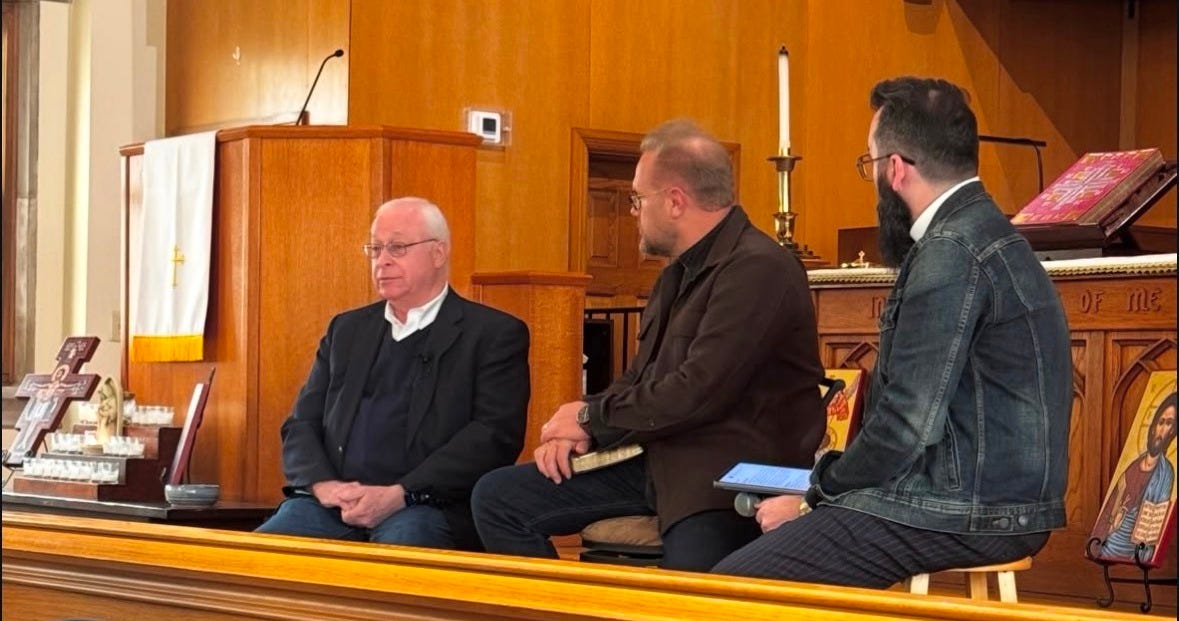
The lecture wasn’t recorded, but I wanted to share the questions I asked to give you a sense of the shape of the conversation. Of particular note was Dr. Moore’s careful reading of Isaiah 8:18-21 as a word on how we engage with the digital world, and Bishop Chris’s consideration that 2 Corinthians 3 calls us to stop simply “gazing” and become those who image Christ in the digital spaces of our worlds.
Here are the questions:
Curated Reality
⁃ Social Media, “Google”, and AI increasingly “curate” reality for us. What does this mean for us? What kinds of judgements are being made on our behalf, and where do those judgements actually come from? Who determines that “what”?
⁃ How would you distinguish between something being “targeted” and something being genuinely personal or human? What gets lost pastorally when that distinction collapses?
Screening Screens
⁃ How does our “contact” with reality work now? What is the difference between mediated access to the world and genuine presence within it? At what point does mediation begin to dislocate or disembody us rather than assist us?
⁃ From a pastoral point of view, what does it mean to say that our experience of reality is increasingly “screened”? What kind of formation—or deformation—does that produce over time?
(Un)Masking
Jeremiah 8:12: They do not even know how to blush
⁃ How do you understand the strange doubleness of social media as both overly private and overly public at the same time? What boundaries does it blur that pastors have traditionally relied upon?
⁃ Why do online interactions so often leave people overexposed and yet unseen or misunderstood (“likes” are more important than quality of engagement)? What is missing from these exchanges that ordinarily grounds human recognition? How does this produce exclusion, alienation, isolation?
Forever Feeds
⁃ Most digital platforms are intentionally designed to discourage leaving, to “trap” you? How does that design choice shape our habits of attention and freedom?
⁃ Is it helpful, pastorally, to think of attention as something that can be “consumed”? What responsibilities follow if that is the case?
o (Think, for example, of how Netflix asks if you want to “exit.” Or how Facebook drives down traffic on posts that link out.)
Content Discontent
⁃ Explain the paradox that platforms devoted to delivering new “content” seem to undermine contentment itself? What does that suggest about the economic and spiritual logic at work?
⁃ If contentment would in fact threaten the current digital economy, what pressures does that place on pastors who are trying to form people in patience, sufficiency, and gratitude?
⁃ Do the everyday terms we use—“feed,” “scroll,” “likes,” “followers”—quietly shape how we understand ourselves and our desires? How seriously should pastors take this kind of linguistic formation?
⁃ What would a careful, non-alarmist account sound like—one that acknowledges real goods in these technologies while still naming genuine risks?
If you’d like to join as a paid subscriber and support my writing, then I’d deeply appreciate it. I use that support to fund a book project rather than create a paywall on new posts. Not everyone wants to take on a paid subscription though, I get that, but sometimes we all like the chance to say “thanks”. So there’s also a “buy me a book” option if you’d prefer.
Discord, for those not “in the know” is an online platform or digital community.
Richard B. Hays, The Moral Vision of the New Testament: A Contemporary Introduction to New Testament Ethics (p. 46).
Jonathan Haidt, The Anxious Generation, chapter 1.