
Doing What Jesus Did
A Session for Tehillah Ministries, Calgary

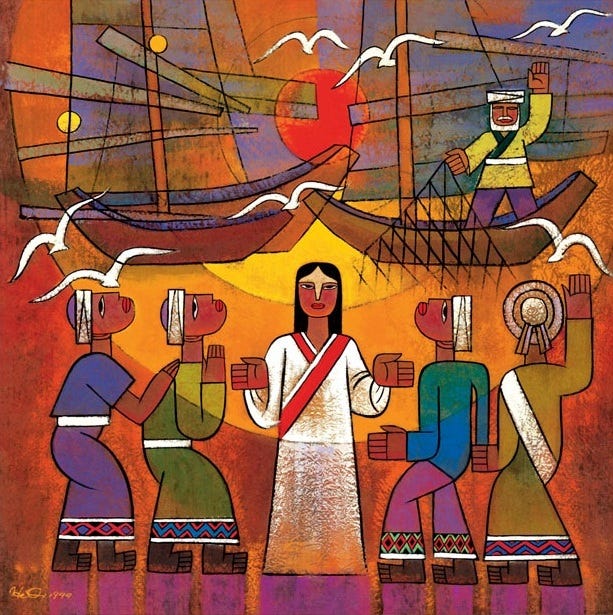
I was invited by Jeremiah niengor to speak at Tehillah Ministries for one of their breakout nights as part of a series on apprenticing with Jesus. I tried to blend some of my thoughts on mission with what the lectionary has been doing recently to shape an idea around my given subject, “Doing what Jesus did.”
We are thinking, tonight and in this course, about apprenticing with Jesus using John Mark Comer’s frame from Practicing the Way: Be with Jesus, Become like him, Do what he did. Specifically here thinking about the third clause: Doing what Jesus did.
Rather than building from Comer’s work, however, I want to engage with a Gospel text that models not simply “What Jesus did”, but what he told his disciples to do. We see this frame presented well in Matthew 9:35-10:20.
The people are described as harassed and helpless in this Gospel. Perhaps you see that in your world too. We live in a constant news cycle that indoctrinates us in panic. A Social Media feed that demands outrage. A low-grade anxiety hums in all of our lives, discipling us into a way of fear. The people Jesus saw were like “sheep without a shepherd” in a world of wars, economic chaos, and political upheaval. Perhaps you see that in your world too. But to that grief, disappointment, and exhaustion Jesus comes with compassion and invites his followers to see this. His compassion, as Karl Rahner might say, is not pity, but a revelation of who he is. This is important to note — something about Jesus’s presence with people is a manifestation of what he is doing in the world.
The harvest is plentiful, but the workers are few.
There is more war than people of peace
There are more thieves than generous givers
There is more fear than there are non-anxious presences
Many of us know the response. It can and must only be “go”. Jesus is surely inviting response. “Be the solution,” must surely be his call. If we read quickly, this is a call to action, mobilization, and mission. Which, of course, it is, but maybe not as we think. Bonhoeffer notes:
[Jesus] does not awaken his disciples’ own offer to proclaim the gospel, nor does he appeal to their love for the people [Volk] and the church-community, but he says: “Ask the Lord of the harvest to send out laborers into his harvest” (Matt. 9:38). In a situation that is very similar to ours, Jesus calls not for self-empowered action but to prayer, asking God to send preachers. For we do not know what is good for the church-community; God alone is to act on his own counsel with the church-community. God alone knows what truly serves the church-community. The fire that burns in us is not supposed to burn in the church-community. God himself wants to kindle the fire on the altar.1
What we hear as a summons to action is a call to prayer. Ironically, it turns out, “thoughts and prayers,” is not Christian insensitivity, but our first move in the face of uncertainty.
As uncomfortable as that is, it perhaps gets worse for the disciples when they are sent out to minister to these shepherdless sheep. Their packing list is unsettling:
“Take no gold, or silver, or copper in your belts, no bag for your journey, or two tunics, or sandals, or a staff” (Matthew 10:9-10)
Terrifying, perhaps, yet Christ also sends them out without something we might recognize as a plan. Pay attention to v.19 where we discover that they don’t even know what they are going to say.
This leads us to the “big reveal”. What is happening here is not what we thought. These people may be sheep without a shepherd, but Christ is not sending them out to be the shepherds our anxieties so desperately need. These disciples, it turns out, are being sent out as “sheep amongst wolves.” Philemon of Gaza explains:
There is no flattery of our pride by making us shepherds with great responsibilities; he sends us out as simple sheep to other sheep which are lost. This is magnificent because a lost sheep which comes across another sheep of its own flock will be quickly reassured and calmed; it will docilely follow the way back to the flock.2
Jesus doesn’t take this ragtag bunch of betrayers, separatists, loyalists, and traitors and turn them into shepherds. He sends them out as sheep amongst wolves (10:16). They are sent out into a hostile climate hoping on the hospitality of others because they have neither resources (10:9-10) nor words to say (10:19-20). Literally, not figuratively, sheep amongst wolves.
The disciples can go out like “sheep amongst wolves” into the political uncertainty, the social media outrage, and the general anxiety, because the one thing they have is sharable peace (10:13). Like Christ in his incarnation, the disciples participate in his need of hospitality and a trust that there are those who are looking for peace.
Jesus is framing what it is to ‘Do What Jesus Did.’
In my church we practice this theologically every week. We gather around Christ, not with a task, but in prayer, we share the peace of Christ with one another, and, as if to prove that is a really blessing, we then are sent out in peace, from the table, just like these disciples, as sheep amongst wolves looking compassionately for other people of peace.
Pay attention: Christ assumes that on this journey they will not meet other Christians, or necessarily people like them, they are looking for those open to his peace.
In advance of any mission of the disciples Jesus knows that God’s grace is already active in the people the disciples will meet. They are not bringing God to the godless, they are finding the places where God is already working. It’s as if Jesus sees the human as fundamentally a being who is embodied, lives in time, flourishes in relationships, but also is oriented towards God’s peace.
Jesus defines his followers’ presence in the world as what Russian spirituality and literature would call Yurodivy (юродивый - yoo-ROH-di-vihy), the Holy Fool. Perhaps best known by Dostoyevsky’s “Idiot” Prince Myshkin, the Holy Fool is the character who embraces foolishness, eccentricity, poverty, or social marginality and in doing so creates space to expose truth through vulnerability. A Yurodivy never dominates and is rarely impressive in the conventional sense.
•
Here is where we need to, perhaps, critique the Practicing the Way model of, be with Jesus, become like him, and do what he did. It’s often attempting to brand discipleship as a sensible program. But with the deepest respect, what Jesus describes here is not some sort of religious self-improvement plan. The subtle challenge in Comer’s work, present in much of the contemporary Western Church’s understanding of discipleship, is that it comes to us as optional. We remain the active agents in a “plan” that we hope will make us more Christ-like. What we need to learn is that the freedom that comes from Christ only comes from being submitted to, obedient to, and restrained by Christ. It’s not a “build your own model” system.
This sort of idea is central to the Rule of St Benedict, a 6th century rule for monastics that wanted their spiritual growth to result in Christ-likeness:
One of the spiritual essentials for Christian formation, according to Benedict, is to walk in obedience to God through our accountability to others. Pilgrims who have yielded their hearts to Christ along life’s journey learn the joy of laying down their wills in order to listen to God’s life-giving commands…Christ gave his followers a few commands to obey such as loving God and loving others. We are formed into the likeness of Christ as we discover the joy of living by obedience to God, putting the instructions of Christ into action in our lives.3
Western Church discipleship fails because we build church and formation around our own comfort. We go to services that are shaped around us not Christ, and we want discipleship programs that work like gym schedules. Mission fails because we see it as an extension of this. We tend to see mission as something driven by us. Quite unlike what Jesus asks in this text today. You’ve heard the “harvest is ready…so go” message. This is a human-centric notion of mission. It’s simple, straightforward and “makes sense” to us.
Think about it like this. We have come to talk about “mission” primarily in terms of “thinking” and “speaking”: We will learn what we need to and then go and speak it somewhere. (The reasons for this, I think, are deeply tied up into notions of enlightenment rationalism, modernist individualism and post-modern agency). In short, it seems simple, and rarely are the things of God simple.
Rather, in this gospel Jesus is inviting us to operate, not in terms of thinking and speaking, but in terms of presence and practice. The disciples are not sent out with resources or even an idea of what to say. They are not peddelers and politicians who can just drop into an area with a “message”. Instead they are invited to go and be in and amongst people, reliant on their grace and hospitality. All they have with them is peace and prayer — presence and practice.
Thinking and speaking assumes we are in control, presence and practice invites us into the trust needed as Jesus sends out disciples as sheep amongst wolves. Pay attention to this from Rowan Williams:
…the new humanity that is created around Jesus is not a humanity that is always going to be successful and in control of things, but a humanity that can reach out its hand from the depths of chaos, to be touched by the hand of God. And that means that if we ask the question, “Where might you expect to find the baptized?’ one answer is, ‘In the neighbourhood of chaos’. It means you might expect to find Christian people near to those places where humanity is most at risk, where humanity is most disordered, disfigured and needy. Christians will be found in the neighbourhood of Jesus - but Jesus is found in the neighbourhood of human confusion and suffering, defencelessly alongside those in need. If being baptized is being led to where Jesus is, then being baptized is being led towards the chaos and the neediness of a humanity that has forgotten its own destiny.
I am inclined to add that you might also expect the baptized Christian to be somewhere near, somewhere in touch with, the chaos in his or her own life — because we all of us live not just with a chaos outside ourselves but with quite a lot of inhumanity and muddle inside us. A baptized Christian ought to be somebody who is not afraid of looking with honesty at that chaos inside, as well as being where humanity is at risk, outside.4
I think if we are going to be a people of “mission” who “do what Jesus did”, we need to think more openly about our spiritual practices — Sacraments: Baptism, Eucharist, and Sacramentals: ordered prayer, blessings of peace, and intentional, incarnational presence in our part of the world. The way I would recommend learning to do that, is from the ancient church. This stuff isn’t new. Read the Rule of St Benedict, consider what it was to vow into a life of practices and contemplative presence in the world. Consider the Franciscan Order, probably one of the best known of the Christian religious orders in the world. It has a rule of life at its core. The Rule of St. Francis, authorized by Pope Honorius III in 1223, has as its first words:
The rule and life of the lesser brothers is this: To observe the holy gospel of our Lord Jesus Christ, living in obedience without anything of our own, and in chastity.
Their ordered life assumes presence and practices rooted in a proximity to Jesus. Hilarion Kistner, in The Gospels According to Saint Francis, frames it like this for us:
Discover Christ in the Gospels and all of Scripture and in a prayerful way get deeper and deeper into his mind and heart, and then you can, as Francis liked to say, “follow the footprints of our Lord Jesus Christ.” That is what Francis himself wanted to do and wanted his followers to do as well.
What St Francis does so helpfully for us today is deeply Evangelical. To be with Jesus, become like him, and do what he did is to take “the Gospel as your rule of life.”5
This is what the LORD says: “Stand at the crossroads and look; ask for the ancient paths, ask where the good way is, and walk in it, and you will find rest for your souls. But you said, ‘We will not walk in it.’” - Jeremiah 6:16
This is why a church service [should] take a particular shape. We gather around Christ and the Gospel, proclaim peace to one another, and then from the table of the Lord we are sent out in peace. Our service becomes service. Having practiced the presence of God amongst his people, we are sent out in service to God amongst others who are open to his peace. If our service ends with “have a great week,” we have forgotten why we were there in the first place — to be sent out as peace for the world.6
Here’s the rub: In baptism and in the spirit, we are already with him and like him, so we can, therefore, go out as sheep amongst wolves, and do what he did: be present as peace in and for the world.

My book, with Cody Matchett, Hearing in the Dark: Reflections on Christian Spiritual Formation is available on Amazon. We’d love for you to pick up a copy and leave us a review. It’s a small book, easy to keep on a night stand for some bedtime reading, or drop in your bag to read during a quiet moment. We hope you like it.
Dietrich Bonhoeffer, Theological Education Underground 1937-1940 DBWE 15, p.430.
Philemon of Gaza Meditates Matthew’s Gospel, p.105.
David Robinson, Ancient Paths: Discover Christian Formation the Benedictine Way, p. 26.
Rowan Williams, Being Christian, p.3
Brother Ramon, Franciscan Spirituality, p.105.
Alexander Schmemman: “Then the priest says: ‘Let us depart in peace’. This does not mean, of course, that having accomplished our religious duty we can now simply go home and ‘relax’. How can one return from the Kingdom? And yet we are given this order, and it is precisely as an order that those words must be understood. This gives the Eucharist its last dimension – that of Mission.”
That contrast between “thinking and speaking” and “presence and practice” lands hard. In much of our ministry language, mission can become a project we manage rather than a people we learn to receive. Jesus sends His disciples vulnerable, dependent, and carrying peace. That arrangement corrects the instinct to arrive as experts.
It asks us to become neighbors before we become explainers. In recovery work, street ministry, and ordinary parish life, people often recognize the gospel first in whether we can stay present without controlling the outcome. Prayer and hospitality are not preliminaries to mission. They are part of its grammar.