
Come, Wild Goose
Pentecost as neither monopoly nor loss | Pentecost, Year A

†
Veni, Sancte Spiritus, so the Latin invocation goes.
Come, Holy Spirit.
But what do we imagine “is” coming when we invoke this third person of the Trinity?
I was raised in a KJV tradition, so we had a “Holy Ghost” to scare our imaginations. Those raised amongst icons and stained glass know that the Spirit is a “Dove”, because that is what we see at Jesus’s baptism.
If we can briefly ignore that the Greek word for dove is just the Greek word for pigeon, I wonder if we like the image of the Spirit as a dove - “flightly”, timid, pretty, and appropriate at weddings and funerals.
But is a dove the image that fits John’s description of the Spirit?
“The wind blows where it wills, and you can hear the sound it makes, but you do not know where it comes from or where it goes; so it is with everyone who is born of the Spirit.” (3:8)
This sounds more akin to the Spirit we meet in Genesis holding together the chaos of the uncreated universe. So perhaps we need to learn from the Celtic Christians. When they spoke of the Holy Spirit they talked not of a dove but of a wild goose. Unpredictable. Rambunctious. Brave. Filling us with a mix of wonder, fear, and beauty. This Spirit, as Lewis said of Aslan in the Narnia Chronicles, is good, but maybe not as safe as we’d like.
Pentecost gives us a fiery Spirit, when we want a tame dove. We want a controllable Spirit, we get a wild goose.1 The Spirit as a dove seems more like the Lord’s pet. I wonder if we don’t even like that? In the scriptures, however, the Spirit we meet is our wild God himself.
The Spirit is our God.
Perhaps our reduction of the Spirit isn’t just to “tame” him but to diminish? While we all pray in the name of the Father, Son and Holy Spirit, I wonder if we pause before saying “the Spirit is our God”. We definitely wouldn’t be the first congregation to do this. In the 4th Century, the Cappadocian theologian, Gregory of Nazianzus preached about the extent of the Spirit’s equality:
Look at the facts: Christ is born, the Spirit is his forerunner; Christ is baptized, the Spirit bears him witness; Christ is tempted, the Spirit leads him up; Christ performs miracles, the Spirit accompanies him; Christ ascends, the Spirit fills his place. Is there any significant function belonging to God, which the Spirit does not perform?
Is there any title belonging to God, which cannot apply to him, except “ingenerate” and “begotten”?… He is called “Spirit of God,” “Spirit of Christ,” Mind of Christ,” “Spirit of the Lord,” and “Lord” absolutely; “Spirit of Adoption,” “of Truth,” “of Freedom”, “Spirit of Wisdom,” “Understanding,” “Counsel, “Might,” “Knowledge’‘ “True Religion” and of “The Fear of God.” The Spirit indeed effects all these things, filling the universe with his being, sustaining the universe. His being “fills the world, his power is beyond the world’s capacity to contain it. It is his nature, not his given function, to be good, to be righteous and to be in command. He is the subject, not the object, of hallowing, apportioning, participating, filling, sustaining; we share in him and he shares in nothing. He is our inheritance, he is glorified, counted together with Father and Son… he is, like God, a “fire,”…who created and creates anew through baptism’ and resurrection. The Spirit it is who knows all things, who teaches all things, who blows where, and as strongly as, he wills,’ who leads,’ speaks, sends out, separates,… reveals, illumines, gives life—or, rather, is absolutely Light and Life. …All that God actively performs, he performs. Divided in fiery tongues, he distributes graces, makes Apostles, prophets, evangelists, pastors, and teachers. …He is “all-powerful, overseeing all and penetrating through all spirits that are intelligent and pure and most subtle”—meaning, I think, angelic powers as well as prophets and Apostles. He penetrates them simultaneously, though they are distributed in various places; which shows that he is not tied down by spatial limitations.2
Perhaps we can only respond like the people do in Acts (2:12): “What does this mean?”
Amongst other things Gregory seems to want us to hear clearly that God is not in anyway diminished by the Spirit. The Father and the Son are not less by the Spirit being fully God. “He shares in nothing…he is not tied down by spatial limitations.” Jesus has ascended to the Father but we do not have less of the Father or the Son because we now have the Spirit. Jesus goes away so that we can have him more fully. (We are formed like him by the spirit because he went “away”)
This is not, of course, simply trinitarian reflection, it is true of how the Spirit works in us too. If God is not shrunk or tamed by the Spirit, neither are we. This is one thing the praising God in many languages of Acts 2 is prophetically showing us. As Moses said in Numbers 11:29, “I wish that all god’s people were prophets,” or as St Paul in 1 Corinthians 12, all the graces of the Spirit are “one and the same.” The work of the wild Spirit is not to diminish us, but to call us into the fullness of our wild humanity — Parthians, Medes, Elamite, etc., etc… But also to call us, pay attention, “as” Parthians, Medes, Elamite, etc., etc…. The truth of ascension carries to Pentecost. This God is not trying to make us less human, but more human, not less “us” but more “us”. Andrew Davison preached it well:
Within the grace of God, there is no zero-sum. For one perspective to flourish more, another does not need to flourish less. The well-being of one group of us does not require less well-being of another. The glory of God is not better manifest if we are all effaced, rubbed out, made the same: better to be radiant in our distinct ways, than generically transparent.3
This is what Pentecost is showing us. This is what Pentecost makes us. A pentecost people. A people who know that in the Spirit there is no zero-sum. We recognize that there is room at the table for you , as you, and me, as me. We are not made less by the presence of another. This is true individually and as church. We are not less Pentecostal because we are also Sacramental. We are not less Evangelical because we are liturgical. We are not less spiritual because we care about justice and wholeness.4
As the Apostles discovered in the Gospel (John 20:22), to receive the Spirit is to breathe the same breath as Jesus. We are not diminished by this. And neither is he. We are never diminished by the work of God, but neither do we ever have the monopoly, rather we have God himself as our God. We breathe his breath, speak from his Spirit, and be his people for the world. There is now no other version of us that does not have God as our God. We cannot own him, diminish him, monopolize him, yet he is also ours.5
Maybe this is why the Celtic Christians are correct. We need the wild goose. We would have the Spirit make us safe by making us all look the same. That would seem safe, but it wouldn’t be good. To be really good, we need to breathe his breath and allow the Spirit to work “goodly” so that, “in our own languages we hear them speaking about God’s deeds of power.” (Acts 2:11)
And so we [bravely] pray, Veni, Sancte Spiritus
Amen
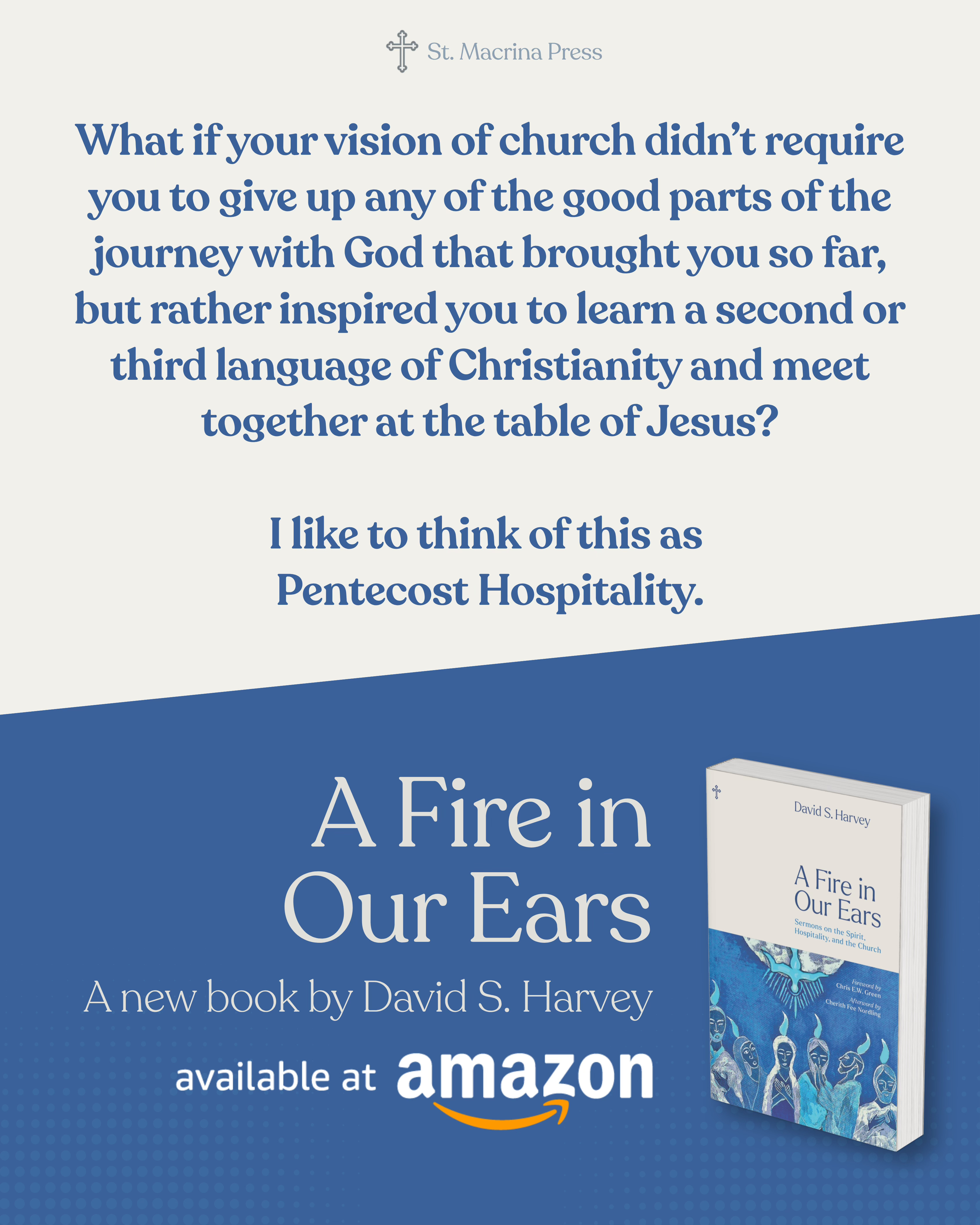
I really am excited to let you know that A Fire in Our Ears: Sermons on the Spirit, Hospitality, and the Church is now available to order from Amazon at any of their sites around the world. You will be familiar with much of the journey in the book, but I think it’s come together in a really beautiful book that will grace a coffee table well.
When you’re ready to get a copy, search it on Amazon, or use the following links:
Amazon USA: https://www.amazon.com/dp/B0GXZP42BP
Amazon Canada: https://www.amazon.ca/dp/B0GXZP42B
Amazon UK: https://www.amazon.co.uk/dp/B0GXZP42BP
As my friend Fr. Phil Aud once said to me, we want the Spirit with no chaos, but I don’t think we can have both.
Gregory of Nazianzus, Oration 31, 30.
He gives over 50 biblical references to support this argument. O for preaching like this today.
Andrew Davison, ‘With God there is no Zero-Sum’: A Sermon for the Closing Mass of the Anglican Catholic Future/ Forward in Faith Conference 20. Thanks to my friend Deacon AJ Jansen for sending me this sermon.
This last point is well made in my friend Fr. Joash P. Thomas “The Justice of Jesus”.
Karl Rahner, The Great Church Year, p.211.