
Bring What You Have
A Eucharist for the 5,000 | Proper 13 (17), Year A

†
The lectionary preserves us from hearing the horror story that precedes the Feeding of the 5,000. In doing so, however, we might miss that the news that Jesus has just heard is that of the beheading of his cousin, John the Baptist, to satisfy the whims of the maniacal Herodias (Matthew 14:1-12). We might be projecting into the narrative silence, but we meet a grieving Jesus sailing to quiet “in a deserted place” in order to, we assume, be alone.
The crowd, as per usual, has a different idea. Undeterred by his water voyage they hike the lake in order to, what can surely only be called, harass Jesus in his moment of pain. Unsurprisingly, Jesus’s compassion overwhelms his pain, and he ministers to the crowd. In a self-sacrificing move we see the Jesus in action that Paul tells us about in Philippians 2 — setting aside himself for us.
The disciples, it seems, have not forgotten about Jesus’s original plan, however, so as evening falls, they point out that Jesus has, in fact, made it to a deserted place as intended. Their care for Jesus apparently outweighs their concern for the crowd, so they suggest exiting the people.
Playing uninvited spiritual director to Jesus turns out to be a difficult game.
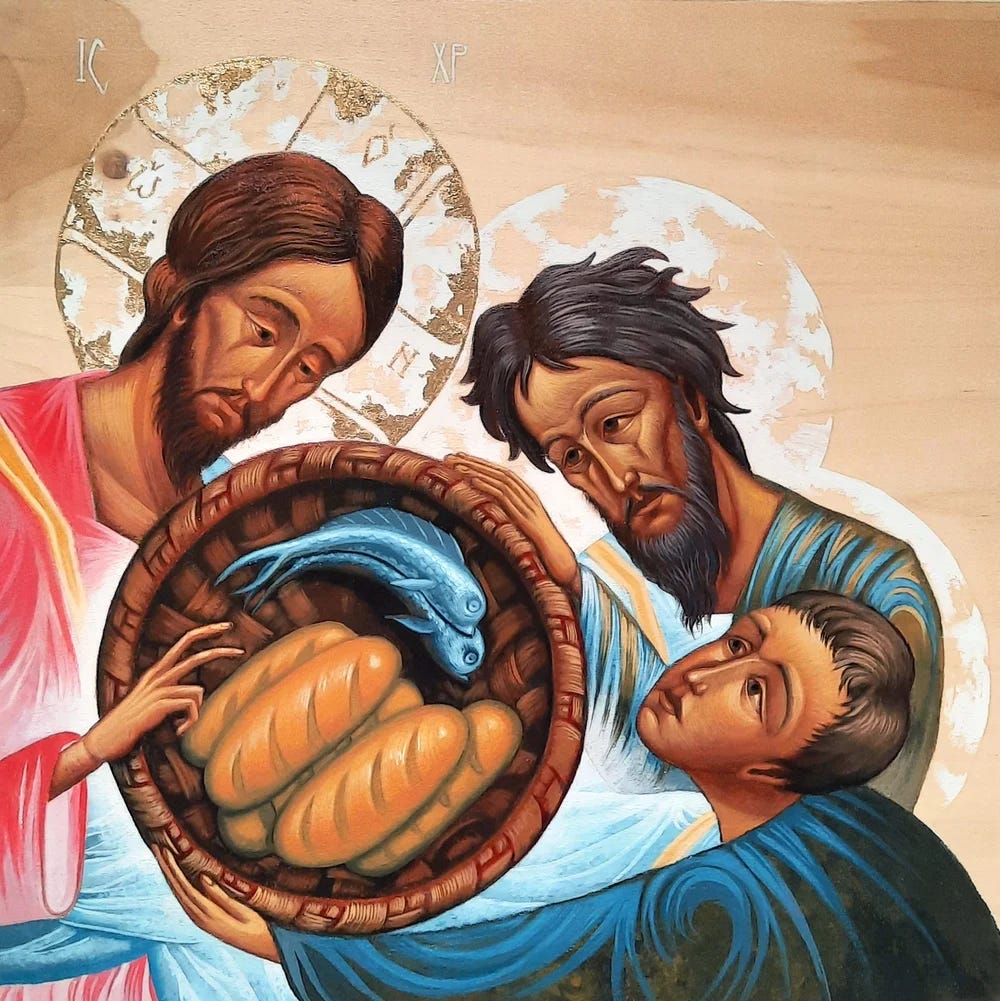
The disciples clearly hadn’t considered a third option between jettisoning the crowd and Jesus’s quiet time — that Jesus might ask the crowd to stay and have the disciples feed them:
Jesus said to them, “They need not go away; you give them something to eat.” (Matthew 14:16)
Jesus calls his disciples into a priestly, pastoral ministry. He invites them to see the people’s needs over their capacity. Jesus served in a moment of grief, how will the disciples serve in a moment of apparent lack? “How can we help?” the disciples seem to say:
“We have nothing here but five loaves and two fish.” (Matthew 14:17)
“We can’t feed them, all we have is some food!” The need of the world will always seem greater than our capacity to make a difference. What we have to offer will often seem inconsequential when faced with that need. The irony of saying this as a priest is not lost on me. In the midst of all that goes on in the world, we turn up to our congregations and offer them…bread and wine. “What difference will this make?” is what we might think. Bread and wine, five loaves and two fish.
Jesus said, “Bring them to me.”
Perhaps all we can say about Christian discipleship and ministry could be summed up by this invitation from Jesus. We take what we have, and rather than holding it tight in Scrooge-like fashion, we open our hands and offer it to Jesus — just as he did with his life. In this sacrificial move, we are positioned to learn the truth of this miracle: The little we have is enough.
Intuitively we assume this is someone else’s lunch the disciples are repurposing for the miracle, but in Matthew’s telling of the story the food is theirs. Theirs to bring to Jesus. Measly when faced with 5,000 rumbling bellies, but offered to Jesus anyway.
The place God calls you to is the place where your deep gladness and the world’s deep hunger meet. Frederick Buechner1
We should probably remember that in Scripture’s bread-traditions, there is always enough bread. No matter how much Manna the Israelites collected in the wilderness they always had enough (Exodus 16:17-18). The widow of Zarephath always had enough bread to feed Elijah (1 Kings 17:16). The kingdom of heaven really is like a woman excessively mixing 50 pounds of bread (Matthew 13:33).
So the disciples bring the bread to Jesus. And Jesus takes them to church. He takes the food. Blesses it. Breaks the bread, and gives it to them to share with the people. This is Jesus doing the priestly work the disciples weren’t yet ready for. Like at the last supper, he takes, blesses, breaks, and gives (Matthew 26:26).
While they were eating, Jesus took a loaf of bread, and after blessing it he broke it, gave it to the disciples, and said, “Take, eat; this is my body.” (Matthew 26:26)
What do the people need? They need Jesus. They need his bread. His food. And they need someone to give it to them. John Bartunek sees the whole of Jesus’s ministry and call in this sacrificial and eucharistic moment.
“It is a summary of Christian theology. Jesus did that with human nature: taking flesh, praying to his Father, suffering his passion, and spreading the Good News. He does it with each of his disciples: he calls them, pours out his grace on them, gives them a share in the cross, and sends them into the world to make more disciples. The Eucharist is Christ’s ongoing love affair with the souls for whom he died, and it makes what it teaches (self-forgetting love) actually happen in those who receive it with faith.”2
Like what happens at every Eucharist table, Christ takes what little we have to offer and turns it into blessing. You cannot give what you do not have, but what you have to give, sacrificially and willingly, is always enough. The temptation of crippling self-comparison will be to offer more than you have, or what you do not have. But you cannot and should not give that. As a pastor the temptation is to be something other than what we are called to be. As Martin Thornton wisely notes, we live in an age where we,
“see priests either as nice kind encyclopaedic seers or as licensed busybodies; an age when they are either avoided or consulted on all subjects except their own.”3
The temptation to be CEOs or influencers, great communicators or life coaches, should give way to what we have been asked: If you love me… take up your cross (Matthew 16:24) and feed my sheep (John 21:17). St Gregory the Great advises:
If, therefore, the care of feeding is a testament to loving, then he who abounds in virtues but refuses to feed the flock of God is found guilty of having no love for the supreme Shepherd. As such, Paul said: “If Christ died for all, then all were dead; and if he died for all, it follows that all who live could not live in themselves, but for him who died and was resurrected for them.” (2 Corinthians 5:15)4
Bring what you have to Jesus. Because you love him, yes, but also because you want your compassion for others to be realized and actualized. As if to make the point visually, this story ends with each of the disciples having a whole basket full of leftovers to carry home. What little we have turns out to be more than enough. Jacob wrestles God for a blessing that God already wants to give him (Genesis 32:22-31). Paul offers up his eternity on the behalf of Jesus’s own people (Romans 9:1-5). But Jesus says bring what you have. Our invitation is to let him take it, bless it, break it into his cruciform image, and then give it back to us to share as a blessing to the world.
Amen.
As for me, I shall behold your face in righteousness; when I awake I shall be satisfied, beholding your likeness. (Psalm 17:15)

My book A Fire in Our Ears: Sermons on the Spirit, Hospitality, and the Church is available to order from Amazon at any of their sites around the world. You will be familiar with much of the journey in the book, but I think it’s come together in a really beautiful book that will grace a coffee table well.
When you’re ready to get a copy, search it on Amazon, or use the following links:
Amazon USA: https://www.amazon.com/dp/B0GXZP42BP
Amazon Canada: https://www.amazon.ca/dp/B0GXZP42B
Amazon UK: https://www.amazon.co.uk/dp/B0GXZP42BP
Frederick Buechner, Wishful Thinking
John Bartunek, The Better Part, p. 287.
Martin Thornton, Pastoral Theology: A Reorientation, p.11
St Gregory the Great, Pastoral Rule, 1§5.
Love this. I was thinking about the Bring what you have line as an invitation to participation the other day 🥰